Council House vs Housing Association: What’s the Difference?
Both offer secure, affordable social housing, but council and housing association homes aren’t quite the same. Here’s how they differ on tenancies, rent, Right to Buy, repairs and complaints, and what it means if you want to swap.
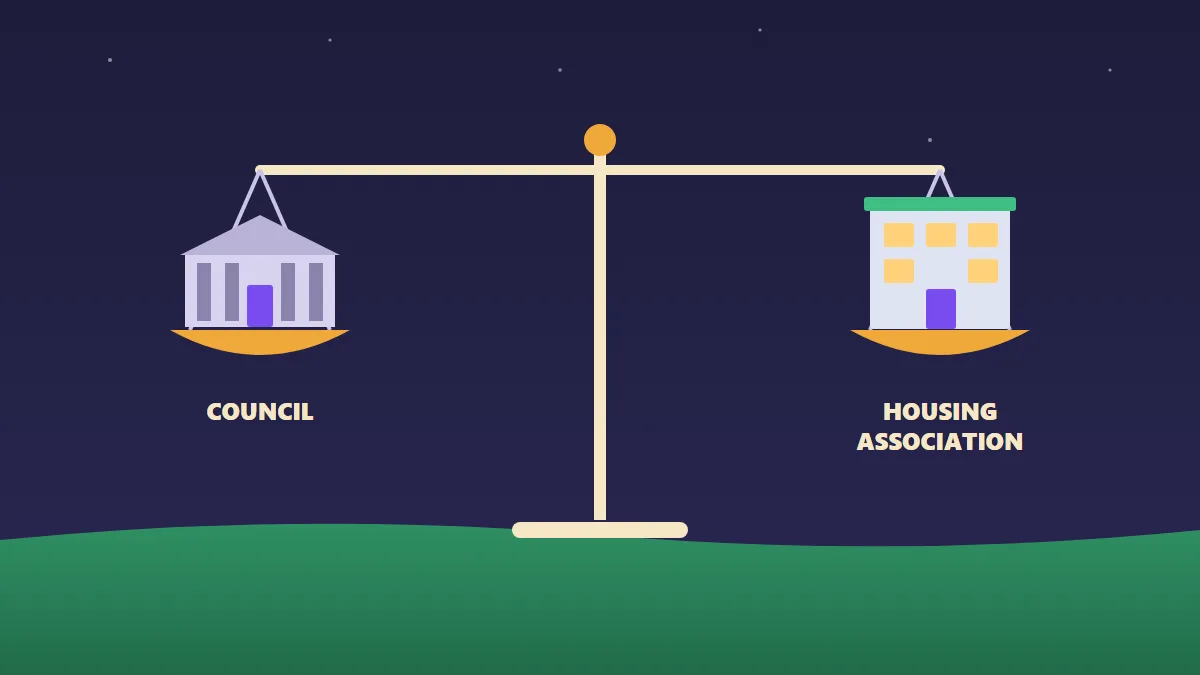
"Council house" is often used for any social home, but many people who say it actually rent from a housing association. The two are close cousins, both providing affordable homes with long-term security, but there are real differences. They matter most when you're thinking about swapping from one to the other.
Who Owns The Home
A council home is owned and managed by your local authority, the same council that collects your bins and council tax. Many councils transferred their homes to housing associations over the last few decades, so not every area still has council housing.
A housing association is an independent, not-for-profit organisation that owns and manages social homes. Some have a handful of homes in one town; others have tens of thousands across the country. Profits go back into homes and services.
In England alone there are around 1,300 housing associations and other registered providers, plus about 230 councils that still own homes. See them all in our list of housing associations in the UK.
Your Tenancy
- Council tenants in England usually have a secure tenancy, normally for life, often after an introductory year. Some councils used fixed-term tenancies for new tenants after 2012.
- Housing association tenants in England usually have an assured tenancy, also long-term, often after a starter period. Some have fixed-term or "affordable rent" tenancies.
Both give strong protection: you can only be evicted on legal grounds, such as serious rent arrears or antisocial behaviour, through the courts. The exact rules differ slightly.
In Wales, both council and housing association tenants now have a secure occupation contract under the Renting Homes (Wales) Act 2016. In Scotland, both usually have a Scottish secure tenancy. So in those nations the difference is mostly who your landlord is.
Rent
Both charge social rents, set using a government formula, usually well below private rents. Some newer homes from either kind of landlord are let at affordable rent, up to 80% of local market rent, which can be noticeably more. Housing association homes sometimes have higher service charges, for things like communal cleaning or gardens. Our place guides show typical council and housing association rents for each area.
Right To Buy
This is one of the biggest differences in England:
- Council tenants with a secure tenancy may have the Right to Buy, after a qualifying period, at a discount. Discounts were cut sharply in November 2024.
- Housing association tenants may have the more limited Right to Acquire, with smaller discounts and only on some homes, or none at all. Some who transferred from the council keep a "Preserved Right to Buy".
The Right to Buy has ended in Scotland (2016) and Wales (2019).
Repairs, Standards And Complaints
Both are regulated. In England, the Regulator of Social Housing sets standards that councils and housing associations must meet on safety, repairs and how they treat tenants, and both must deal with damp and mould under Awaab's Law. If a complaint isn't resolved, tenants of either can go to the Housing Ombudsman. Wales and Scotland have their own regulators and ombudsmen.
Want to know how your landlord performs? Each one in our landlord directory has a profile with its regulator grades and, where published, tenant satisfaction and complaints figures.
Can I Swap Between A Council And A Housing Association Home?
Yes. Mutual exchanges between council and housing association tenants happen all the time. Both landlords need to agree, and each checks the household moving into its home.
The key thing to understand: you usually take over the other tenant's tenancy. So if you swap from a council home to a housing association home, you'll normally go from a secure tenancy to an assured one, and that can affect things like the Right to Buy. Read What Happens to My Tenancy After a Mutual Exchange? before you agree.
At A Glance
- Landlord: council = your local authority; housing association = independent not-for-profit.
- Tenancy in England: council = secure; housing association = assured.
- Rent: both social rent (some affordable rent); housing associations may have more service charges.
- Buying your home (England): council = Right to Buy; housing association = Right to Acquire on some homes, or none.
- Complaints: both go to the Housing Ombudsman in England.
- Swapping: you can swap between them, but your tenancy type may change.
The Short Answer
A council home is owned by your local authority; a housing association home by an independent not-for-profit landlord. Both offer affordable, long-term homes with strong protection. The main differences are your type of tenancy and, in England, whether you can buy your home. You can swap between the two, as long as you understand the tenancy you're taking on.
Ready to look? Search homes to swap from both councils and housing associations, or list your home.